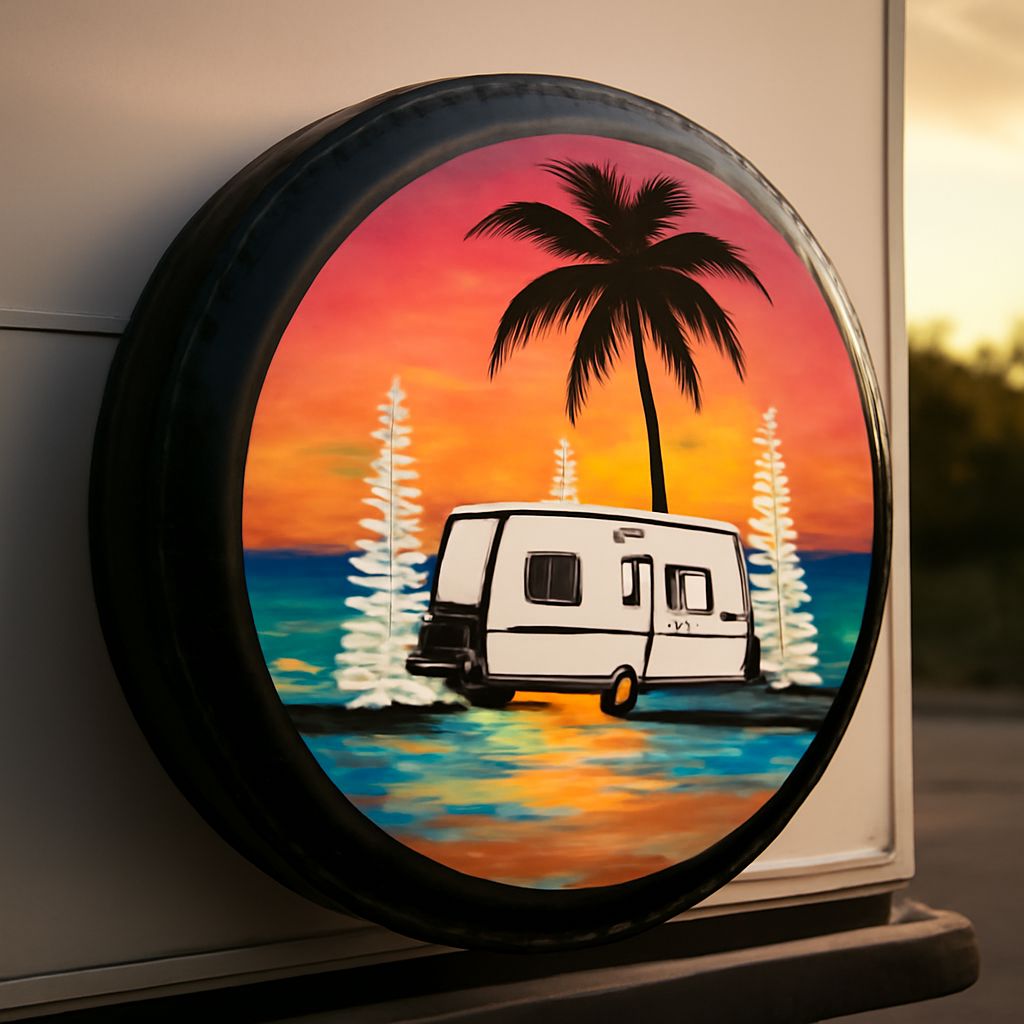
A cover that looks right in a catalog can flap loose on the highway or refuse to fit around a rear-mounted carrier. To choose protection for an RV’s spare tire, measure the inflated tire and its mounting hardware first, then compare the material and fastening. A well-fitted cover for a camper tire should also come off easily when you need the spare.
Sunlight, road spray and dust all reach an exposed spare. A cover for the RV’s spare tire gives it a layer of shelter, while regular checks keep you from discovering a flat or damaged spare on the shoulder.
Camper Tire Covers: Start With the Tire’s Measurements
Read the tire size on the sidewall, such as ST225/75R15, and write down the entire marking. The letters and numbers identify more than the wheel diameter; a 15-inch wheel does not mean the tire is 15 inches across. Sellers often list fit by the tire’s outside diameter and width, and some offer a size chart based on the full sidewall marking.
Measure the inflated tire where it sits. Place a straightedge against the top and another against the bottom, then measure between them through the center for the outside diameter. Measure the widest sidewall-to-sidewall distance for width, allowing for any bulge. A second person can help hold the straightedges parallel. Record both dimensions in inches and compare them with the seller’s stated range.
For a tire marked ST225/75R15, the nominal calculation is approximately 28.3 inches in diameter: convert the 225-millimeter section width to inches, multiply by 0.75 for one sidewall, double it and add 15 inches for the wheel. Actual dimensions vary by tire, so use the measurement and the manufacturer’s fit chart to choose the size. If your tire falls between ranges, ask the seller which size accommodates its width and your carrier.
Account for the carrier and access
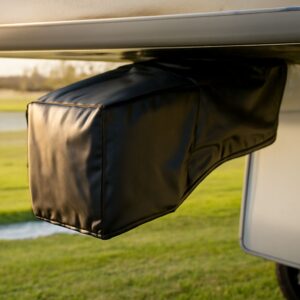
A rear-mounted spare may sit close to a wall, ladder or bumper. Look behind the tire and note the space around the mounting plate, arms and fasteners. Some covers wrap around the back with an elastic hem; others have a zipper or opening that makes them easier to place around a bracket. Check the product’s rear opening and depth, not just the diameter of its face.
Before choosing a camper spare tire cover, consider how the spare comes off. Can you reach the lock, retaining nuts and valve stem? A cover that must be removed for a pressure check is manageable if it releases quickly. If a camera, license plate or light sits nearby, make sure the fabric cannot obscure it. Check clearance as the carrier swings or the vehicle moves, and keep the cover away from exhaust heat.
The same reasoning applies to a travel trailer spare tire cover on a bumper bracket: measure the clearance behind the tire and check that the fastening can close without snagging on the bracket. If the mount has a lock, practice reaching it before your first trip. Keep the key and the tools needed to release the spare somewhere accessible.
Compare materials and fastening
Spare tire covers for an RV commonly use vinyl or polyester fabric, sometimes with a water-resistant coating and a soft inner lining. Vinyl can be wiped clean; fabric options vary in weight and flexibility. Read the construction details and care directions: a thick-looking product is useful only if it fits the carrier and can be secured.
A spare tire cover for an RV benefits from an opaque, UV-resistant outer surface that helps shade the rubber. Water resistance helps shed rain and road spray, while a design that can dry helps avoid leaving moisture trapped against the wheel. Check stitching, seams and the inside surface for rough edges that could rub the tire or wheel finish. A light color may show dirt sooner; choose a finish you are willing to clean.
Some camper tire covers use elastic hems that are quick to install, but the edge must grip behind the tire rather than sit loosely over the tread. A drawstring, strap or buckle can offer adjustment when access to the back allows it. Spare tire covers for trailers should be secured so they cannot billow, drag or interfere with hardware. After fitting, tug gently around the perimeter and check that no loose straps can reach the road or moving parts.
A hard-shell option may provide a more structured exterior, but check its mounting method, clearances and ability to open for inspection. Compare replacement fasteners and return policies too: a cover that fits the measured tire but clashes with the mount may need to go back.
Keep the cover and spare ready
Wash the cover as its maker recommends, generally with mild soap and water, and let it dry before reinstalling. Remove grit from folds and inspect seams, elastic and straps for tears or loss of tension. After a wet trip or long storage period, take it off and let both cover and tire dry. Check for abrasion where the fabric contacts the carrier, and repair or replace a cover that no longer stays secure.
The cover reduces exposure, but air can still escape and rubber still ages. Check the spare’s cold pressure at least monthly and before a trip, following the vehicle and tire manufacturer’s instructions for the correct pressure. Michelin recommends monthly checks including the spare. Look over both sidewalls and the tread for cracking, cuts, bulges or other damage; have a tire professional assess questionable damage before use.
Find the DOT date code on the sidewall and record the week and year of manufacture. Follow the tire manufacturer’s inspection and replacement guidance for that tire: a spare with deep tread can still be old. Also confirm its load rating and any use restrictions suit the vehicle, and check that the carrier and tools are in working order.
Choose an RV spare tire cover whose diameter and width range fits your measured tire, whose rear opening clears the mount, and whose fastening you can operate easily. If two camper wheel covers fit, favor the one that stays secure while giving you practical access for pressure checks and removal.