You want to know whether a charging problem calls for a repair or a replacement, and what evidence supports that decision. Faulty diodes in an alternator are one possible cause. Before you agree to replacing the alternator’s diodes, ask what the shop measured and what else could produce the same symptoms.
The answer matters because a warning light or a weak battery identifies a problem to investigate, not a particular failed component. Understanding the rectifier gives you a way to discuss the findings and compare the proposed work.
What the diodes do
Your car’s electrical system and battery use direct current, or DC. Inside the alternator, a spinning magnetic field induces alternating current, or AC, in stationary windings. Alternating current reverses direction; the battery needs charging current flowing in the appropriate direction.
The rectifier contains diodes arranged to turn that alternating output into current flowing in one direction. Think of each diode as a one-way valve for electricity. The output is not perfectly flat: a small AC variation, called ripple, remains on top of the DC voltage. The battery and the rest of the circuit influence what can be measured at a given point.
The alternator’s diodes can fail in different ways. A diode can fail open, interrupting a path, or short, allowing current where it should be blocked. That can change the output pattern and reduce charging performance. The amount and nature of the effect depend on the fault and the alternator’s design. The rest of the charging system still has to be considered.
Symptoms are clues, not a verdict
A battery warning light, slow cranking, a battery that repeatedly discharges, or lights that flicker can bring the issue to your attention. Fluke describes flickering lights and battery-drain complaints among the possible signs associated with excessive ripple. Tell the shop when the symptom occurs: at idle, with electrical accessories running, after a drive, or after the car has been parked overnight.
A bad alternator diode is one possible explanation, but those observations alone cannot identify it. A weak battery, loose connection, damaged cable, slipping belt or another alternator fault can also affect charging. An overnight discharge may involve a separate electrical draw. The timing and conditions you report help the technician reproduce the complaint and choose the next measurement.
If the charging warning light comes on while driving, follow the owner’s manual and arrange service promptly. The battery has limited stored energy, and the vehicle may eventually stop if it is not being replenished. Don’t disconnect the battery with the engine running as a test: DENSO warns that this can damage diodes.
What ripple measurements show
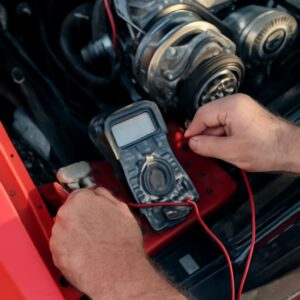
A technician can measure the AC component superimposed on the charging voltage, then compare the reading and test conditions with the relevant service information. Engine speed, electrical load, measurement location and the instrument all matter. Ask for the reading, where it was taken and the conditions at the time, rather than treating a number without context as a diagnosis.
A meter provides a numerical reading. An oscilloscope can show the shape of the ripple over time, much as a picture of waves shows more than their average height. DENSO explains that an irregular ripple pattern can point to open or shorted diodes or to a problem in the stator windings. A test bench may also be used to examine the pattern after removal.
A waveform can therefore direct the investigation toward an internal fault, but an irregular trace alone does not always isolate the defective part. Depending on the vehicle and equipment, the technician may need further testing of the rectifier or windings. A reading at the battery may differ from one at the alternator: a Fluke service manual notes that the battery can absorb some AC voltage. Use the vehicle manufacturer’s procedure and limits for the actual test setup rather than applying a universal cutoff.
How the shop narrows down the fault
The technician relates the ripple result to the complaint and checks the surrounding circuit. For example, an excessive voltage drop across a cable or ground connection can affect charging and must be addressed. DENSO notes that poor connections can reduce charging current and contribute to overheating and premature failure. Battery condition and the drive belt also matter when deciding whether the alternator itself is responsible.
Where the service procedure calls for it, a specialist may remove or disassemble the unit and test the rectifier components. A diode test checks conduction in the intended direction and blocking in the other; other circuit paths can influence an in-circuit reading. Fluke’s diode testing guidance notes that isolating one end may be necessary in some circuits. These tests require the correct procedure for the unit, not a generic reading applied to every car.
Ask the shop to distinguish a confirmed component failure from an internal fault suspected from the waveform. Both are useful findings, but they support different levels of certainty. Request the results on the estimate or work order so you can compare them with the proposed repair.
Alternator diode replacement or a complete unit?
If testing identifies a rectifier problem, an alternator diode replacement may be possible through a specialist who can source the correct parts and test the rebuilt unit. A shop may replace the alternator’s diodes individually, but depending on the design, the practical repair may be a complete rectifier assembly rather than a single diode. When replacing diodes in the alternator, ask what part will actually be installed and whether the shop will test output and ripple afterward.
A complete new or remanufactured alternator may make more sense when the unit has other worn components, suitable parts are unavailable, or removal and rebuilding labor make the smaller repair poor value. Compare the total installed prices, parts quality, turnaround time and warranties. The cheapest component on the bench is not necessarily the least expensive finished job.
Also ask what caused the failure. DENSO identifies reversed battery polarity and certain high-resistance connections among possible contributors. Correcting a damaged connection or other identified cause matters before a repaired or replacement unit goes back into service.
When the diagnosis is complete, ask your technician: “What test result points to the rectifier, what else did you rule out, and would repairing it or replacing the whole alternator be the better value for my car?”